View the milestone timeline at full size · Open the evidence infographicA new mathematical proof can be checked on a computer. A promising molecule still has to be tested in people. A robot that completes a demonstration has to repeat the task through a working shift. These differences explain why AI progress can feel extraordinarily fast in one field and stubbornly slow in another.
As of October 17, 2026, there is substantial progress to report across mathematics, biology, medicine and automation. There are also important claims whose significance is still being established. A useful timeline needs to show both.
One further biology result deserves attention without being promoted to a finished technology. In September, Anthropic reported an enzyme-system lead with CRISPR-like repeats. The team explicitly says its function is not yet known. It is a research lead, not a demonstrated replacement for CRISPR or a new treatment.
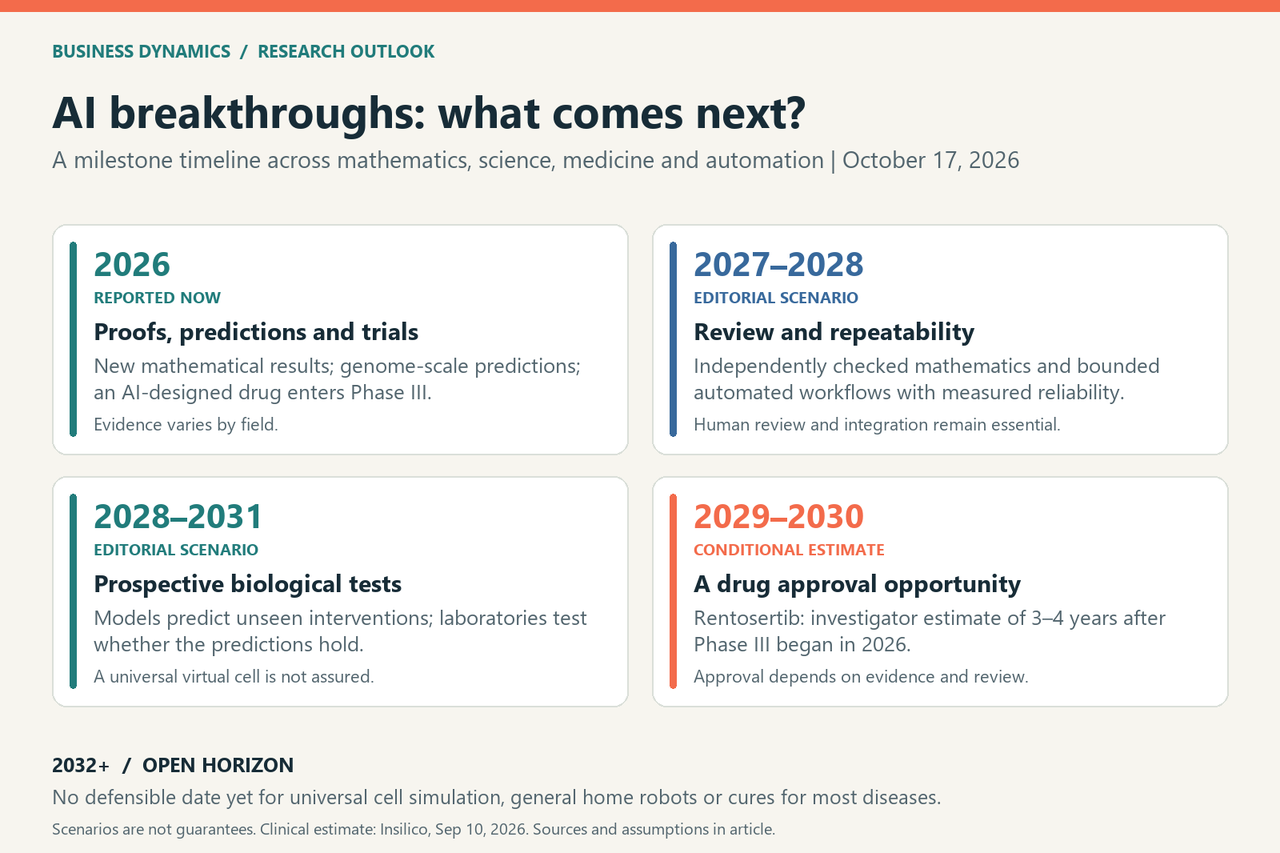
The dates below are planning windows, not promises. Except for the attributed clinical estimate, they are Business Dynamics’ editorial scenarios based on the capabilities and remaining tests described above. They are not a consensus forecast or statistical confidence interval. Progress may arrive earlier, later, or fail to materialize.
2027–2028: more independently checked results and narrower autonomous workflows. In mathematics, the next milestone is outside experts confirming useful new results, with formal verification where appropriate. In automation, watch for bounded workflows that run repeatedly with measured error rates, documented human interventions and reliable recovery. A successful demo alone does not meet that standard. The timing is uncertain; verification capacity and integration work can lag model capability.
2028–2031: stronger evidence for laboratory and biological prediction. A consequential milestone would be models that predict the effects of interventions on previously unseen cells or conditions, followed by successful prospective laboratory tests. On October 7, Biohub and partners announced a $1.8 billion commitment spanning funding, data, computation and measurement technology. That is investment in the foundations for predictive biology, not delivery of a universal virtual cell. The window is an editorial scenario; generating suitable data and demonstrating generalization remain difficult.
2029–2030, conditionally: a possible approval milestone for rentosertib. In the sponsor’s September announcement, the lead investigator estimated three to four years from Phase III initiation to final approval under favorable conditions. That implies roughly 2029–2030 for this program, not a guaranteed approval date or an FDA commitment. Trial outcomes, recruitment, manufacturing and regulatory review can change the timetable. The FDA’s clinical-research overview explains why larger, longer studies remain necessary.
2032 and beyond: broader biological simulation and adaptable robotics remain open questions. It is reasonable to watch for progress, but the sources reviewed do not establish a defensible date for universal cell simulation, general-purpose household robots or cures for most diseases. These belong on a watch list with explicit acceptance tests, rather than a calendar of promised achievements.
The common requirement is a trustworthy feedback loop. Mathematics has proof checking. Laboratory science has repeatable experiments. Medicine has clinical outcomes. Business automation needs an equally concrete measure of whether the requested work was completed correctly.
For example, a laboratory procurement assistant could extract a request, check approved suppliers, draft an order and route it for authorization. Start with historical cases, compare its output with reviewed records, then run a limited pilot. Measure incorrect fields, approval exceptions and duplicate requests as well as time saved. A retry must not create another purchase order; our ERP transaction article explains that engineering problem.
The tradeoff is practical: stronger controls can reduce how much work runs unattended, but they make the results easier to trust and maintain. The planning, CRM and operational applications in our showcase provide familiar settings for that discipline. Business Dynamics can help assess a workflow against evidence, operating constraints and a measurable first release.
Research checked October 17, 2026. Original graphics by Business Dynamics. Forecast windows are editorial scenarios unless explicitly attributed; source links accompany the relevant claims.
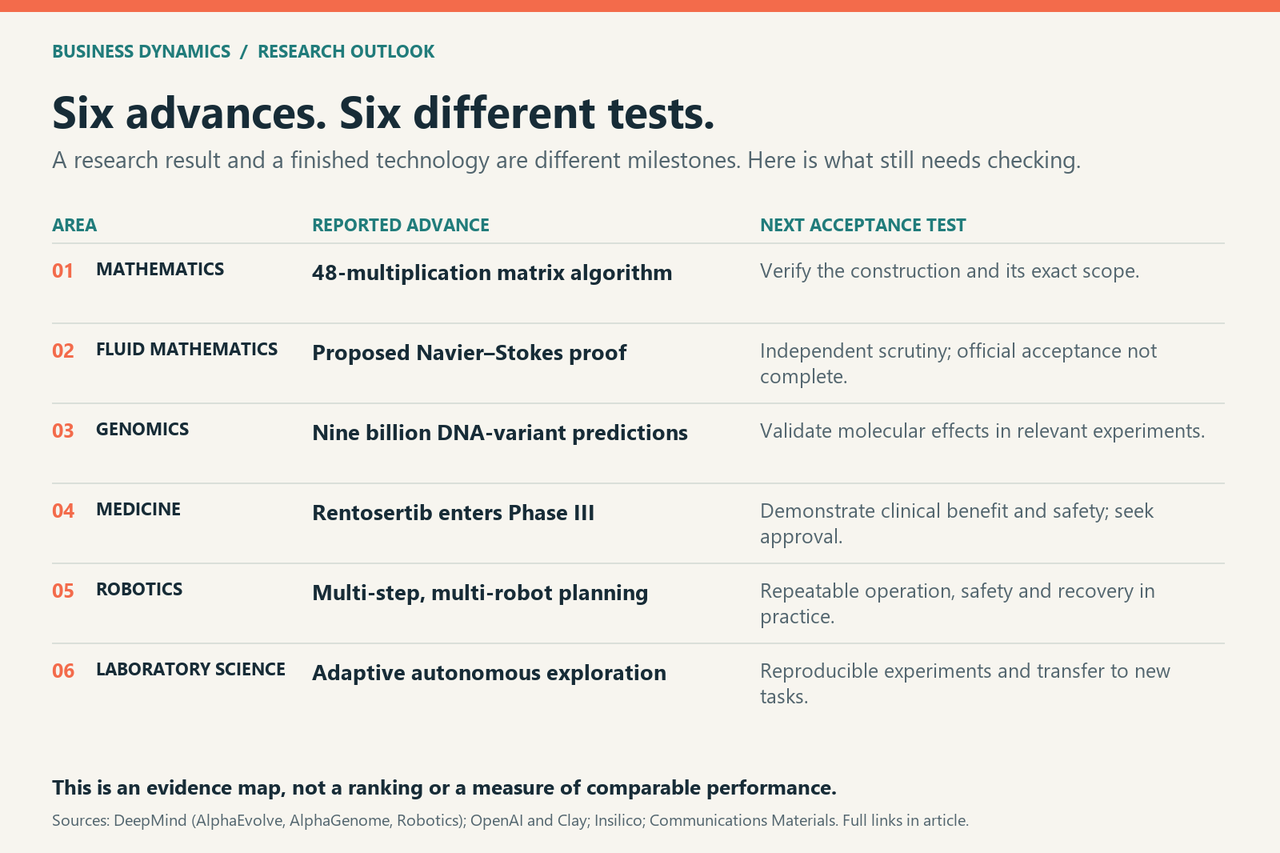
Graphic: six reported advances and the evidence needed to assess each one. Original illustration by Business Dynamics; source links are provided above.